
Software for healthcare, built by people who run it.
The engineers behind eKlotho's IPA platform, EMR, care programs and lab services take on partner work: custom platforms, legacy EMR migrations, payer and device integrations, AI features and the infrastructure underneath.
What we take on
Each of these describes work we have done on our own products. Ask for the specifics and we will walk you through the code.
Custom development
Web, mobile and backend systems for clinics, IPAs, labs and care programs, built on the stack we run ourselves: Next.js and TypeScript on the front end, async FastAPI and SQLAlchemy on the back end, MySQL on AWS.
Every request is scoped by the relationships between organizations, not a flat tenant id, so a health plan, an IPA and a clinic can share one system and each see only their slice.
EMR & data migration
Move off a legacy EMR or practice-management system with an ETL pipeline that extracts, transforms and loads patients, encounters, problems, medications, orders, results, documents and charge history into the new system.
We built this for Aprima, including family history, recall tasks and superbills, with row counts reconciled at every stage and a written migration record you keep.
Integrations & interoperability
Payer EDI — 834 enrollment parsing plus 837/835/278 batch tracking — e-prescribing vendor integration with EPCS, lab result ingest, partner APIs with per-organization keys, and device ingest that is idempotent on device and timestamp.
Public terminology services (RxNorm, NDC, LOINC, ICD-10, NPPES) are wired in and cached locally so lookups stay fast and offline-safe.
Infrastructure designed for HIPAA
AWS hosting with RS256 JWTs in httpOnly cookies, S3 document storage behind signed URLs, Redis reachable only from services, and audit logging on the records that matter — sign events, controlled-substance prescribing, verification ledgers.
Designed for HIPAA obligations under a BAA: we document the controls, hand over the runbooks and keep production identical to the main branch so drift is visible.
AI in clinical workflows
An ambient scribe that turns visit audio into a draft note with Whisper speech-to-text, suggests diagnosis codes and maps them to HCC categories — every draft reviewed and signed by the clinician, nothing filed automatically.
Vision-model extraction for faxed requisitions and scanned documents, and AI features that degrade gracefully: if the model key is absent the product still works, it just does less.
Advisory & fractional CTO
Product strategy, vendor evaluation, security review and a phased roadmap for organizations without an in-house engineering lead.
We write the spec, run the reviews and sit in the vendor calls, then either build it or hand a buildable plan to whoever does.
Discover. Design. Build. Operate.
The same process we use for our own releases, with you as the approver at each phase boundary.
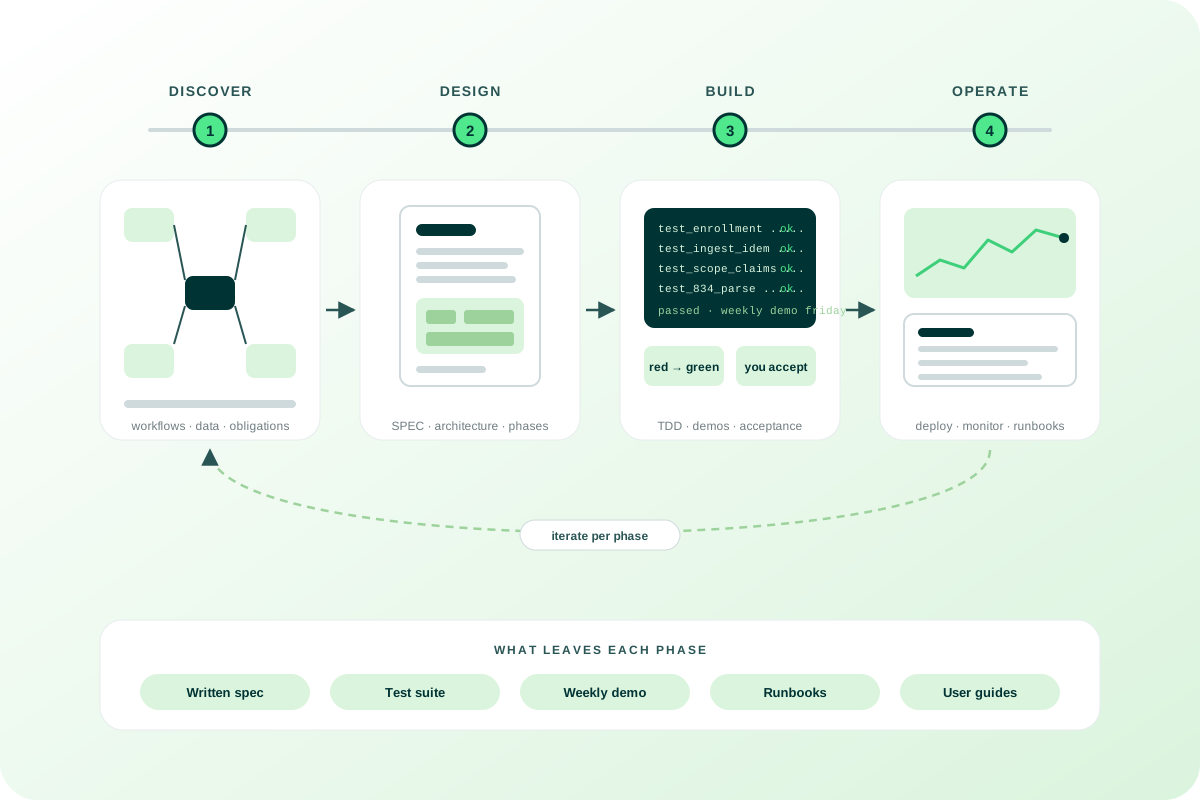
Discover
We map the workflows, the data you already hold and the obligations you carry — payer contracts, delegation scopes, BAA terms — before anything is designed.
Design
Architecture, a written spec with acceptance criteria, and a phased plan with the migrations, seed data and tests each phase needs.
Build
Test-driven: failing tests first, then the code, then a weekly demo on real seeded data. You accept each phase before the next starts.
Operate
Deploy, monitor, support and iterate. Runbooks and user guides ship with the software, not after it.
Deliverables, not just deployments
Every engagement leaves the artifacts your team needs to run and extend the system without us.
Written specification
Scope, data model, acceptance criteria and the phase plan — the document the build is measured against.
Test suite
Unit and integration tests written before the code, run on every change, handed over with the repository.
Weekly demos
Working software on seeded data every week, with a self-check report of what passed and what did not.
Runbooks
Deploy, rollback, backup, migration and incident procedures for the people who will operate the system.
User guides
Per-feature guides — overview, quick start, how-to, edge cases, FAQ — surfaced inside the product.
Questions buyers ask first
Are you HIPAA certified?
There is no government HIPAA certification, and we do not claim one. We design and operate systems for HIPAA obligations under a Business Associate Agreement: access control, encryption, audit logs, documented controls and runbooks you can show an auditor.
Do we have to use your products to work with you?
No. Engagements stand on their own. If the work touches a chart, claims or a care program, our services can be part of the answer, but many engagements are migrations, integrations or infrastructure for systems we did not build.
Who owns the code and the data?
You do. Work is delivered into a repository you control, with the spec, tests, runbooks and guides. Migrated data is reconciled and documented so you can verify it without us.
How do you handle a migration from a legacy EMR?
Extract from the source database or export, transform into the target model with every rule written down, load in stages with row counts reconciled at each one, then run the migration incrementally from a timestamp so the clinic keeps working until cut-over.
What does an engagement cost and how long does it take?
It depends on scope, so we do not publish a rate card. Discovery produces a phased plan with a cost and timeline per phase, and you can stop at any phase boundary.