Lab Services

From order to result, with the patient in the loop.

CLEAR (clearstd.com), built on the eProbatio platform, runs consumer diagnostics end to end — Ship Kit, Home Kit and clinic-visit ordering, CLEAR Pass membership, kit chain of custody, a lab verify-and-release gate with director co-sign, PASS certification reporting and shareable, identifier-redacted results.

Overview

Order online, collect anywhere — results verified by the lab.

CLEAR is a consumer diagnostics platform: a patient chooses a test panel online, has a collection kit shipped home or books a visit at a partner location, and reads the result in a secure portal once the laboratory has verified and released it. Behind the consumer brand is eProbatio, the platform that connects patients and laboratories and runs the chain from checkout to result. The platform progress record describes the consolidation that produced it — marketing site, patient portal and home-kit funnel, formerly three properties with three logins, now one domain with one account, one staff console and one admin panel, operated under a business associate agreement (BAA).

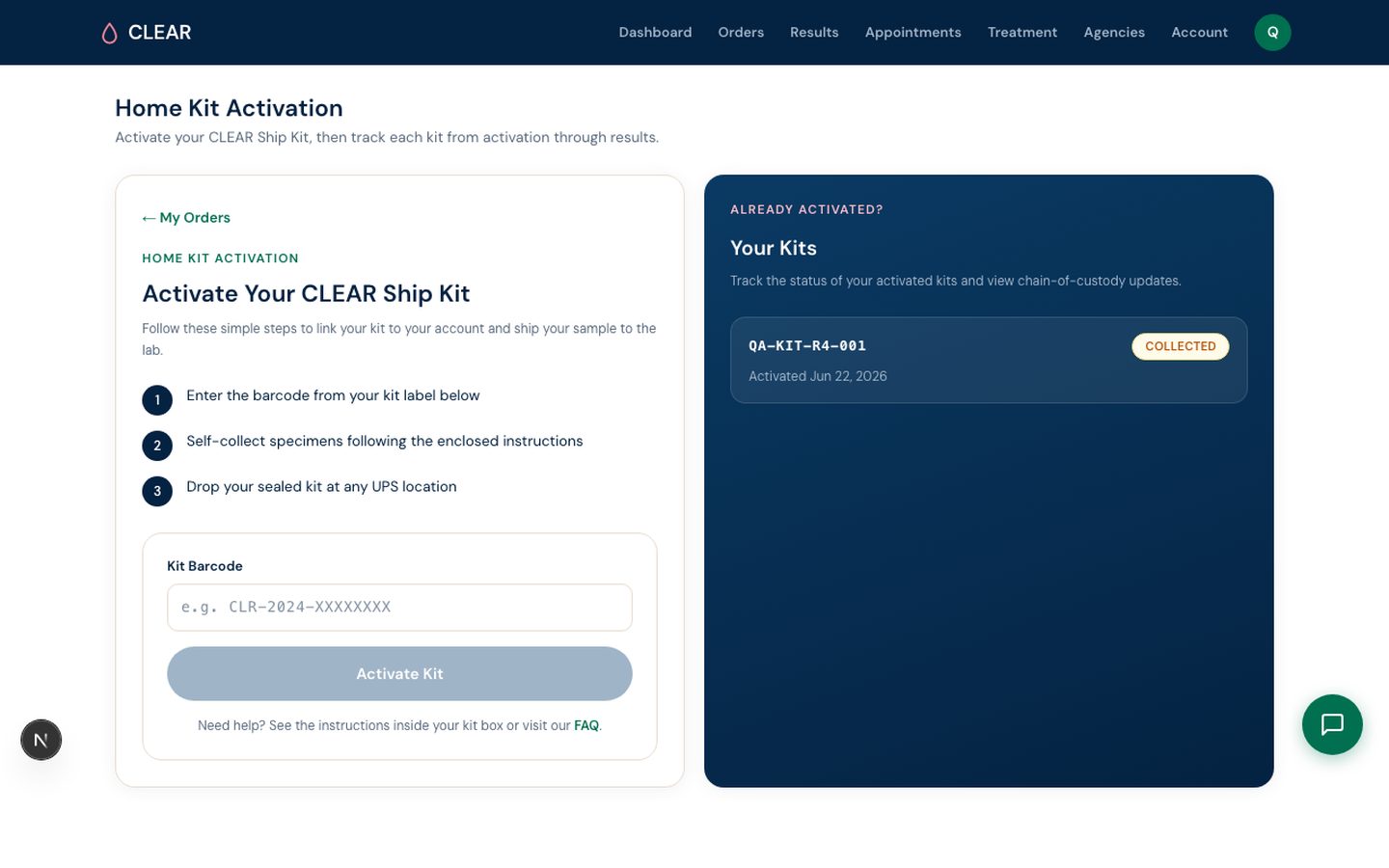
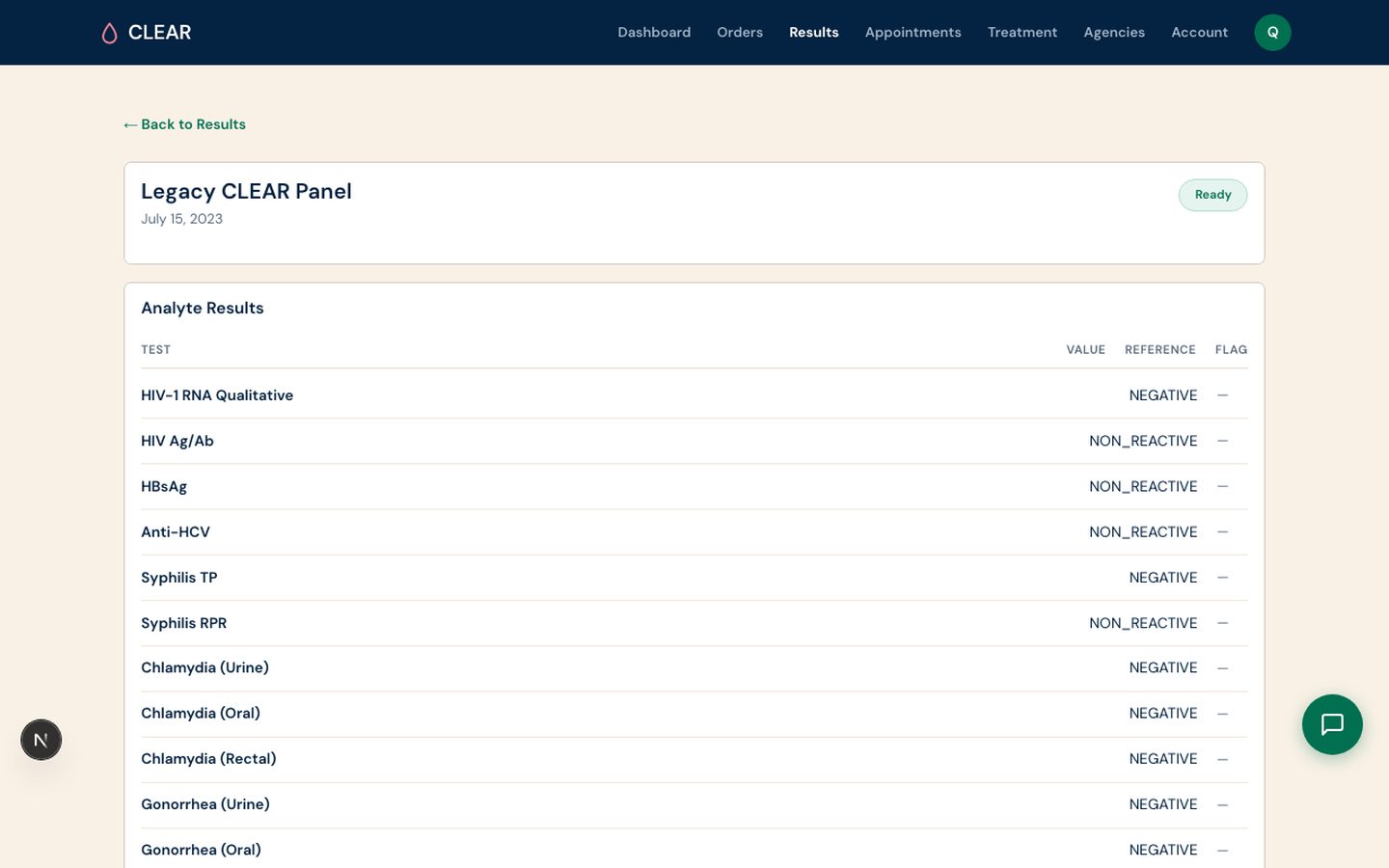
Three consumer paths are documented and built. Home Kit is a four-step checkout — choose kit, shipping, payment, done — that creates the order and its shipment with no appointment; Ship Kit ships the kit and adds a partner-site blood-draw appointment; a clinic panel books a location, date and time; CLEAR Pass is a monthly membership checked out as a subscription, with a Pass and a Pass+ tier and a 'manage plan' path for existing members. From there the order is a single record a patient can follow: a shipped kit activated by barcode, a chain-of-custody timeline from shipment through receipt at the lab, and a result page with analytes, reference ranges and flags.

For laboratories and programs it is an engine with explicit gates. Manually entered results start as drafts, must be verified and released by different people, hold on critical values, and wait for a Lab Director co-sign when abnormal; direct-to-consumer (DTC) panels are authorized by physician-signed standing-order protocols stamped on each released result. One per-panel switch decides whether a result is reported to the PASS clearance database and carries the certified-partner mark, and one redaction library decides how much of the patient's identity each surface — full PDF, no-PHI summary, QR share, PASS, analytics — is allowed to show. Results do not constitute a medical diagnosis; telehealth and treatment routing exist for results that need a conversation.

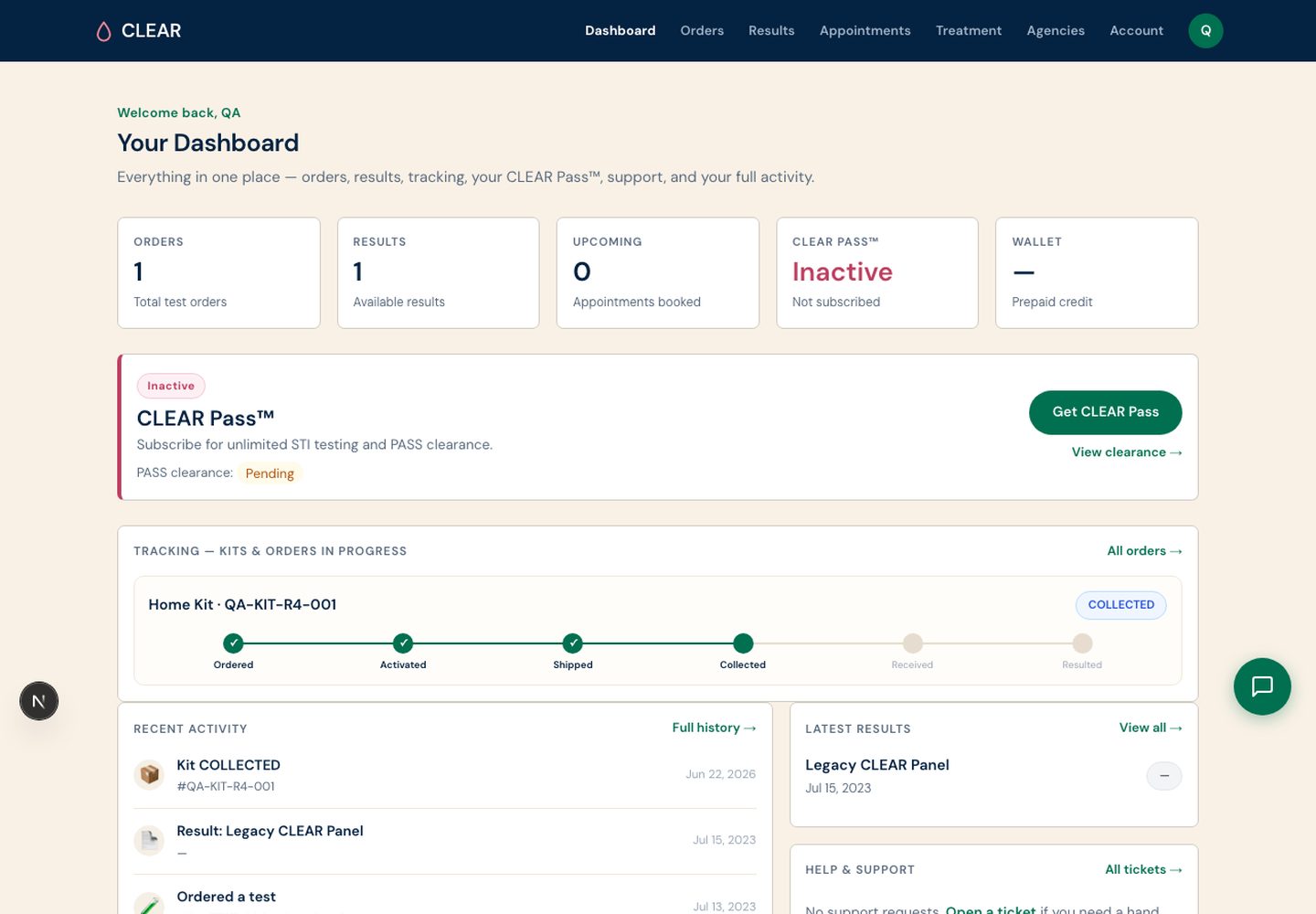
Lab Services — main screen
Lab Services — main screen (demo environment, synthetic data).
Who uses it

Built around the people doing the work

Patient

Needs · To pick a test, know the price and turnaround up front, collect at home or at a nearby location, and read the result without a phone call — or share it when asked to.

Gets · Online ordering for kits and clinic visits, a shipped kit activated by barcode with its custody timeline, results with analytes, reference ranges and flags once released, a full or no-PHI document, and a revocable QR share link.

CLEAR Pass member

Needs · Recurring testing on a membership, a clearance that productions and agencies can trust, and a way to prove status without handing over the full report.

Gets · Pass or Pass+ subscription management, clearance status and a PASS report on the dashboard, automatic reporting of qualifying results to the PASS database, a certified-partner mark on the PDF, and one-time or continuous sharing with agencies.

Agency administrator

Needs · To see current clearances for the performers who work with the agency, manage who at the agency can view them, and never hold more than the member chose to share.

Gets · An organization with admin and standard members, invitations with accept or decline, results shared org-wide by members, and identifier-minimized views on every shared surface.

Lab director / technologist

Needs · To receive and accession kits, enter or import results, keep a second person between entry and release, hold critical values, and sign off on abnormal results as the director of record.

Gets · The lab interface for receive, accession and QC; result entry, XLSX import and API sync; the draft → verified → released gate that refuses the same person twice; a critical-value hold; the Lab Director co-sign; amend and discrepancy handling with history.

Program lead / ordering provider

Needs · To order panels for a wellness or telehealth population under a signed protocol and receive results without building an integration from scratch.

Gets · A healthcare-provider account with API keys and API documents, physician-signed standing-order protocols that authorize DTC panels, test-order creation, and result delivery to the ordering provider.

Support and operations staff

Needs · To find a patient's order, kit, appointment or result in one place, fix what is wrong inline, answer the ticket, and know that the PASS push actually went through.

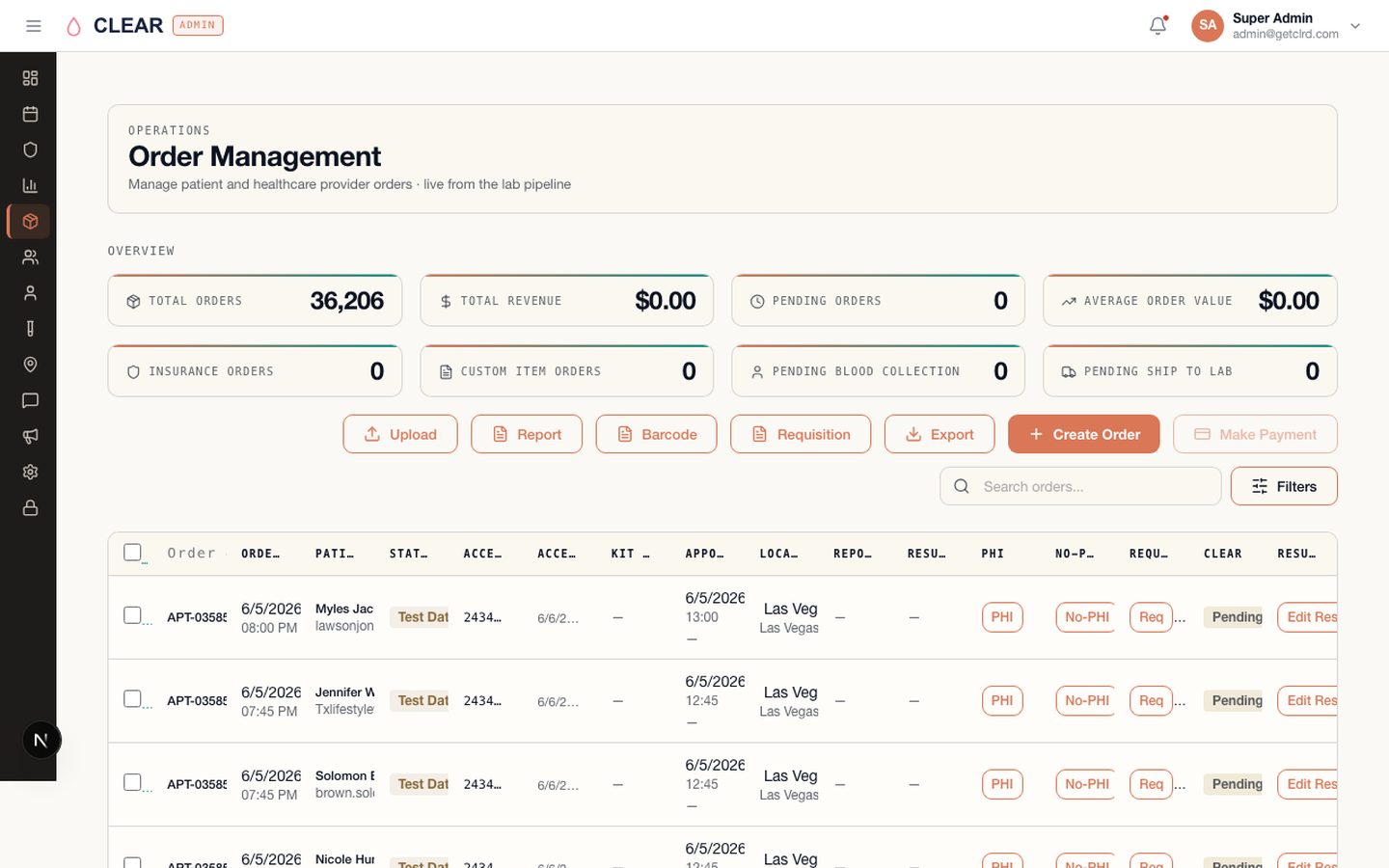
Gets · The admin panel's orders with inline editing, shipments, billing, tickets, communications, alerts and incidents; the staff console's kit and result queues; a PASS-failures tab with retry; and an audit log on every record.

Today vs. with eKlotho

What actually changes

AreaTodayWith Lab Services
OrderingThree separate sites — marketing, portal, kit funnel — and order buttons that ended at an account page.One domain, one account: Ship Kit, Home Kit, clinic visit or CLEAR Pass from a single checkout, with credits or a covered tier applied automatically.
Specimen trackingA kit is mailed and everyone hopes; nobody can say where it is between the mailbox and the bench.UPS label and tracking on the order, barcode activation, and custody events with actor and time that the patient and staff both see.
Result releaseOne person types a result and it goes out; a typo reaches the patient.Draft results must be verified and released by a different person; critical values wait for acknowledgement; abnormal results wait for the Lab Director.
PASS reportingSomeone remembers which panels are industry panels and keys the result into a second system.One per-panel switch: qualifying results are reported at save time, the PDF mark follows the same switch, and failed pushes queue for retry.
Proving a resultA screenshot of a PDF that anyone could edit, or an emailed document with the full record attached.A time-boxed share token that resolves to an initials-only clearance card with a CLIA banner, a no-PHI summary document, and agency sharing the member controls.
Partner integrationClinics order by email and chase results by phone.Provider accounts with API keys and documents, orders placed by API, and results delivered back to the ordering provider.
Capabilities

What's included

10 modules, each describing what is built today.

Catalog, panels & ordering authority

Test items and panels with pricing, channel and availability, plus the two flags and the signed protocols that decide what a result may become.

Consumer checkout — Ship Kit, Home Kit, clinic, CLEAR Pass

The canonical, auth-gated order flow documented in the consumer order processing record, reusing one proven order endpoint.

Kits & chain of custody

A kit is a tracked object from the moment it ships until the lab receives it, and every step is an event a patient and staff can both read.

Appointments & partner locations

Clinic visits scheduled from the same account as kits, against real location hours and slot capacity.

Lab interface

The laboratory's working surface: receive, accession, QC and result entry.

Verify → release & director co-sign

No manually entered result reaches a patient on one person's say-so.

PASS certification & reporting

How a CLEAR result becomes a clearance in the PASS database, as described in the PASS reporting guide and relationship map.

Sharing & identifier redaction

One redaction library with named profiles decides who is shown on each surface; what analytes print is a separate decision.

Patient portal

One account for everything a patient does after checkout, documented page by page in the UAT guide.

Staff console, admin panel & provider API

Two operations surfaces — a staff console and a full admin panel — plus accounts and keys for organizations that order on behalf of patients.

In depth

How it actually works

Ship Kit · Home Kit · CLEAR Pass

Three ways to order

Before the rebuild there was no working order process on the consumer site. Marketing calls-to-action dead-ended at an account or pricing page, the order form posted to an endpoint that did not exist, and the only flow that actually completed an order lived in a legacy funnel outside the design system. The consumer order processing record documents the replacement: one canonical, sign-in-gated checkout that reuses the one proven order endpoint for every kit product.

The four-eyes gate

Verify, then release

A manually entered result moves through four explicit states — draft, pending verification, verified, released — and only a released result can reach a patient. The verify, release and sign-off steps each refuse the person who entered the result: the platform answers with a refusal that says a different person must act, not with a silent success. That second pair of eyes is a property of the system, not a policy memo.

One switch per panel

The PASS relationship

PASS — the performer-industry clearance database — is wired to the catalog through one per-panel switch, set explicitly and never guessed from a panel's name. A PASS-enabled panel's completed results are reported to the clearance database and its documents carry the certified-partner mark; home-kit, general-public and LGBTQ+ screening panels are never reported. New panels default to off, so a panel cannot be reported by accident, and the same switch feeds the reporting push, the PDF mark and the clearance footnotes — three surfaces that therefore cannot disagree.

Identifier redaction, by profile

How much of you a PDF shows

The redaction design note starts from an insight: two different questions were being conflated. Who is this patient — name, full date of birth, medical record number — is one axis; which analytes print on a given document is another. Hiding an analyte never de-identifies anyone, and stripping identifiers never hides a finding. CLEAR separates them: per-item flags decide what prints, and a single redaction library decides who is shown.

Custody events, not recollections

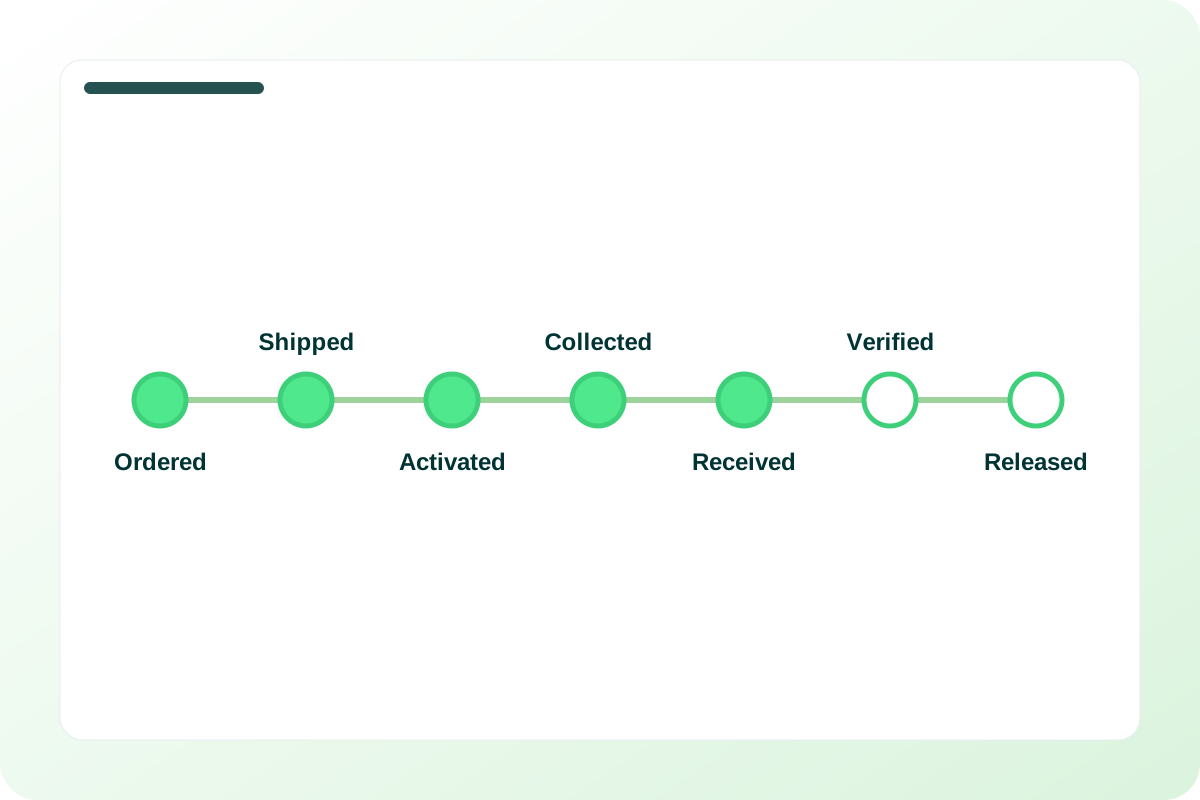
Chain of custody for a box in the mail

The remediation record is candid about the before-state: the collection workflow logged nothing. Steps lived in the browser as local state, so once a visit ended there was no record of who collected what, when, or with which barcode. The chain-of-custody phase replaced that with a custody event store — every step is persisted with the acting user, a timestamp and optional photo or barcode evidence, alongside required-test checks drawn from the order itself.

How it works

From first step to outcome

  1. Choose

    The patient picks a panel, sees price and turnaround and pays — one-time by card, with wallet credits, or covered by a CLEAR Pass tier.

  2. Collect

    A kit ships with a tracked label and is activated by barcode — Ship Kit adds a partner-site blood draw — or the patient books a clinic visit; the custody record starts at shipment or arrival.

  3. Receive and accession

    The laboratory marks the kit received, records the accession and QC status, and enters or imports the results.

  4. Verify and release

    A different person verifies and releases; critical values are held until acknowledged and abnormal results wait for the Lab Director's co-sign; the authorizing standing order is stamped on the result.

  5. Report to PASS

    If the panel is PASS-enabled and the completed result qualifies, it is reported automatically and the clearance is recorded with its expiry; failures queue for retry.

  6. Read and share

    The patient reads analytes in the portal, downloads the full or no-PHI document, shares a QR card, or shares with an agency; reactive results route to a consult request.

A closer look

Screens and flows

Kit activation & custody
Kit activation & custody — barcode activation and the chain-of-custody timeline (demo environment, synthetic data).
Result detail
Result detail — analytes with release state and sharing (demo environment, synthetic data).
Admin orders queue
Admin orders queue — orders and kits worked by staff with status filters (demo environment, synthetic data).
How we make sure

The mechanics behind the claims

Every promise on this page maps to something the software actually enforces.

No result reaches a patient unverified
Manually entered results carry a verification status (draft, pending verification, verified, released) and are delivered only once released; the verify and release endpoints refuse the person who entered the result.
Critical and abnormal values are held
A result flagged critical cannot be released until someone acknowledges it, and the acknowledging user and time are stored. A result marked for director review cannot be released until a user with the Lab Director role co-signs.
PASS reporting and the PDF cannot disagree
The panel's passEnabled flag is read by the save-time push, by the PDF renderer for the certified-partner mark, and by the footnote gate. Reporting defaults to off for new panels and is toggled per panel in the admin.
Identifier redaction is one rule, applied per surface
A single redact(record, profile) function returns the identifier view for FULL, NO_PHI, SHARE, PASS and ANALYTICS; the per-item analyte flags feed only the analyte filter and never the identity shown.
Shared results cannot be forged
Sharing creates a token; the public page resolves it on the server to a minimal clearance card with a CLIA banner, expired or revoked tokens return a clear 'link expired' state, and the member can revoke at any time.
Specimens are traceable
Custody events (pre-visit, arrival, collection, labeling, completion, shipped, received) are rows tied to the kit, sample, appointment or order with actor, timestamp and optional photo or barcode, surfaced in the kit chain and order timeline.
Outcomes

What changes for your team

  • One domain, one account and one checkout instead of three sites and a dead-end order button
  • Every kit traceable through stored custody events from shipment to receipt
  • Results released only after a second person verifies, with director co-sign on abnormal findings
  • PASS reporting that cannot disagree with the PDF, because one panel switch drives both
  • Identifier redaction that means the same thing on every surface
  • Laboratories and ordering organizations integrated by API keys, not email
FAQ

Common questions

Terms on this page

CLIA
Clinical Laboratory Improvement Amendments — the US regulation a laboratory operates under; the public QR card carries a CLIA verification banner.
DTC
Direct-to-consumer — tests a patient orders for themselves; here authorized by a physician-signed standing-order protocol rather than a per-patient order.
Standing-order protocol
A versioned, physician-signed protocol that authorizes a set of DTC panels; the active protocol is stamped on each released result.
PASS
Performer Availability Screening Services — the performer-industry clearance database; a qualifying CLEAR result from a PASS-enabled panel is reported to it and becomes a 30-day clearance.
passEnabled / passRequired
The panel switch that decides whether results are reported to PASS, and the per-item flag that decides which analytes block a clearance.
Verify → release
The two-person gate on manually entered results: one person verifies, a different person releases; nothing is delivered before released.
Redaction profile
A named identifier level — FULL, NO_PHI, SHARE, PASS or ANALYTICS — that decides how much of a patient's identity a document or surface shows.
CLEAR Pass
The monthly membership, in Pass and Pass+ tiers, that covers recurring testing, generates a PASS report and a shareable clearance with a badge.
Chain of custody
The stored sequence of custody events — pre-visit, arrival, collection, labeling, completion, shipped, received — each with actor, timestamp and optional photo or barcode, that accounts for a specimen from shipment to the bench.
Accession
The laboratory's intake record for a received specimen: an accession number, the receiving technician, a QC status of pass, fail or hold, and notes — the point where a mailed kit becomes a lab work item.
What are the three consumer order flows?

Home Kit is a four-step checkout — choose kit, shipping, payment, done — with no appointment. Ship Kit ships the kit for self-collected samples and books a partner-site blood draw in the same flow. CLEAR Pass is a monthly membership checked out as a subscription, with Pass and Pass+ tiers. Clinic panels book a location and time in the same checkout.

Who reviews results before release?

The laboratory. Manually entered results pass a verify-and-release gate that refuses the same person at both steps; critical values are held until acknowledged and abnormal results require a Lab Director co-sign. Results do not constitute a medical diagnosis; a result that needs a conversation routes to a telehealth consult or treatment.

What is PASS and when is a result reported?

PASS is the performer-industry clearance database. A result is reported only when its panel has the PASS switch on, the result is completed and within 30 days, and every required item is negative; the clearance expires 30 days after the result date. Home-kit and general panels are never reported.

What does 'no-PHI' mean here?

Identifier redaction, not hiding analytes. A single redaction library with named profiles decides who is shown: the full document carries name, date of birth and MRN; the no-PHI summary carries a first name or stage name and birth year; the QR card carries initials only; analytics carry nothing.

How are direct-to-consumer panels authorized?

By physician-signed standing-order protocols — versioned documents managed in the admin that authorize a set of DTC panels. The active protocol is stamped on each released result, so ordering authority is traceable without a per-order signature.

Can an agency or program see results for its people?

Yes, when the member shares them. Performers share with another performer or with an agency, one-time or continuously; agencies have admin and standard members who view results shared org-wide. Ordering organizations get provider accounts with API keys and receive results for the patients they ordered for.

Is patient data used in analytics?

Only page views are tracked, and every event passes a guard that removes name, email, date of birth, phone, address, analyte, result and diagnosis keys before it leaves the browser.

Can a released result be corrected?

Yes, with a record. A released result is amended with a reason and the prior versions are kept, so the history of what the patient saw is never overwritten. A result flagged discrepant is blocked from every delivery surface — portal, document and QR share — until the discrepancy is resolved.

What happens if the push to PASS fails?

Nothing is lost and the result is unaffected. The push is fire-and-forget, so a network failure never blocks or delays the save; the failed push lands in a staff-visible failures queue where each entry can be retried individually, and an administrator can test the PASS connection before retrying. Editing a result re-reports it.

See Lab Services on your own workflows

We walk through it with your data and your team — not a canned demo.

Program and billing eligibility are determined by each practice and its payers. Results and alerts do not constitute a medical diagnosis. Third-party names are trademarks of their respective owners and do not imply endorsement.