IPA Solution

Run every delegated function on one contract graph.

eKlotho Nexus is the operating platform for Independent Practice Associations (IPAs), MSOs, PHOs and ACOs that take delegated responsibility from health plans. Utilization management, credentialing, claims, population health, risk pools and regulatory reporting run on one entity-aware record — the same record the clinics chart in.

Overview

Delegated UM, credentialing, claims and quality — on one contract graph.

An Independent Practice Association (IPA) is a network of independent physicians that contracts with health plans under capitation or shared-risk arrangements. The plan delegates operational functions — utilization management (UM), credentialing, claims processing and quality reporting — and the IPA runs them day to day for hundreds of physicians, answering to each plan under delegation oversight. That position, downstream of plans and managed care organizations (MCOs) and upstream of contracted providers, is the one eKlotho Nexus was designed around. IPA COOs and Medical Directors are its primary users, and the platform is organized the way their week is: what each plan has delegated, what is due back, and whether the organization can answer a delegation audit from the system.

Nexus is not multi-tenant software with one tenant per IPA. It models the payer–provider relationship graph: regulators, health plans, MCOs, IPAs, ACOs, PHOs, MSOs, TPAs, FQHCs and individual providers, joined by first-class relationships — DELEGATION, VALUE_BASED_CONTRACT, CONTRACTED_PROVIDER, SERVICE_CONTRACT, EMPLOYMENT and CREDENTIALING. A delegation carries its scopes (UM, credentialing, claims, quality) and effective dates, and every user's session is scoped by those relationships. A plan sees the slice it delegated, an MSO sees its client IPAs, a provider sees its own panel, and the IPA sees all of it — with no permission lists to maintain.

On that graph sit the modules an IPA runs: the prior-authorization workstation, credentialing and provider network, a claims workstation, enrollment and eligibility records, population health with care gaps and RAF/HCC (Risk Adjustment Factor / Hierarchical Condition Category) intelligence, care coordination, risk pools and capitation, grievances and appeals, regulatory filings, communications, documents and administration. Because the eKlotho EMR charts on the same patient record, a signed encounter in a clinic is already visible to UM, quality and claims, and a referral placed in the chart opens a review in the IPA's own authorization queue — no interface engine, no nightly sync, no re-keying.

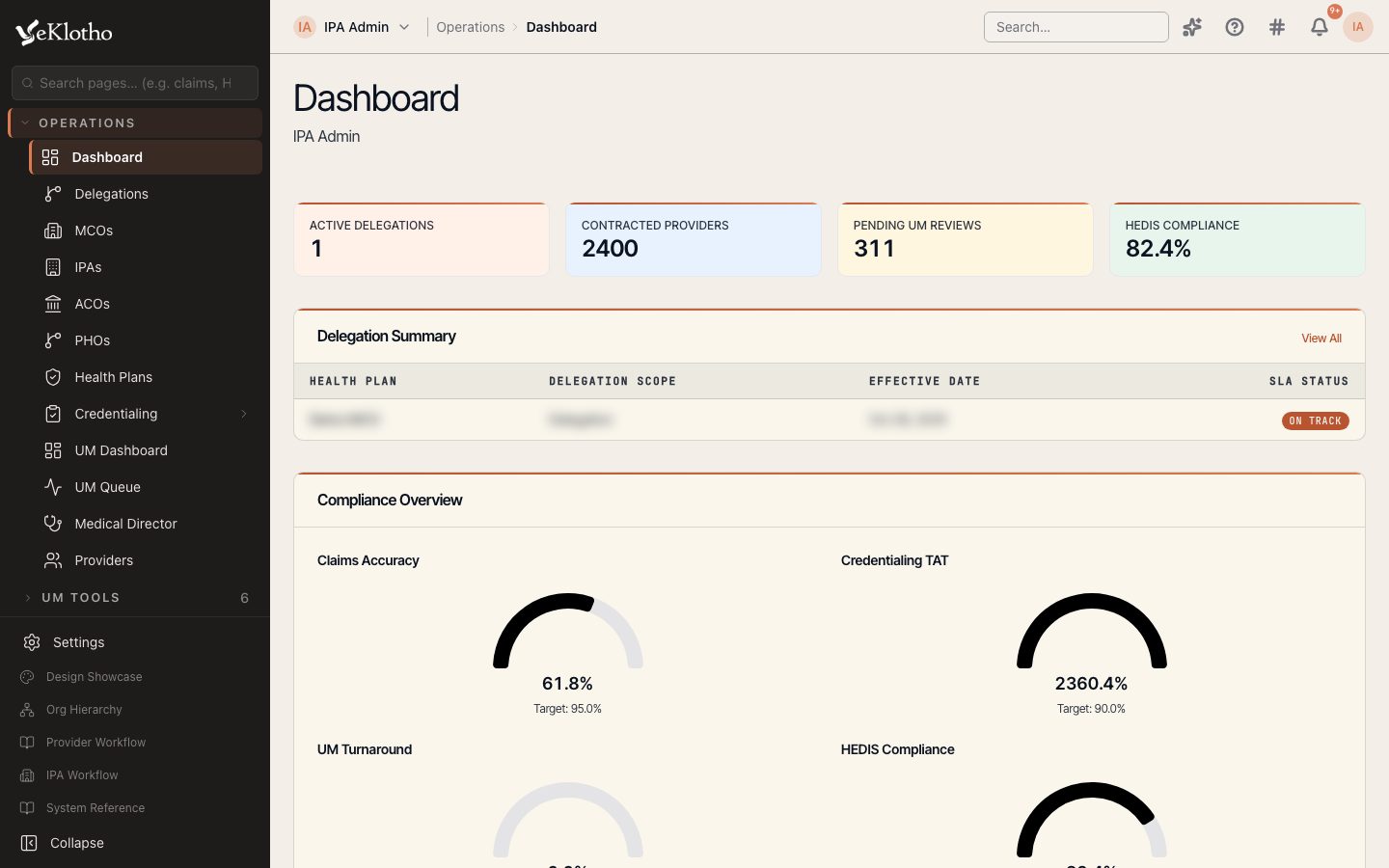
IPA Solution — main screen
IPA Solution — main screen (demo environment, synthetic data).
Who uses it

Built around the people doing the work

IPA COO

Needs · One place to see what each health plan has delegated, what is due to them, and whether the organization can answer a delegation audit this week.

Gets · Delegation records scoped by function with reporting calendars, an attestation tracker, organization pages showing provider composition and adequacy counts, and executive dashboards that read from the same rows the teams work in.

Medical Director

Needs · Reviews that need a physician's decision in one prioritized list, committee decisions recorded defensibly, and quality and risk figures that match what the plan will see.

Gets · The Medical Director UM queue with criteria and a recorded determination, PDF determination letters, committee decisions with rationale, HEDIS measure tracking, the Stars dashboard and the RAF score dashboard.

Director of UM / UM nurse

Needs · A prior-authorization queue with criteria at hand, low-risk services cleared automatically, and a clean hand-off for anything outside the rules.

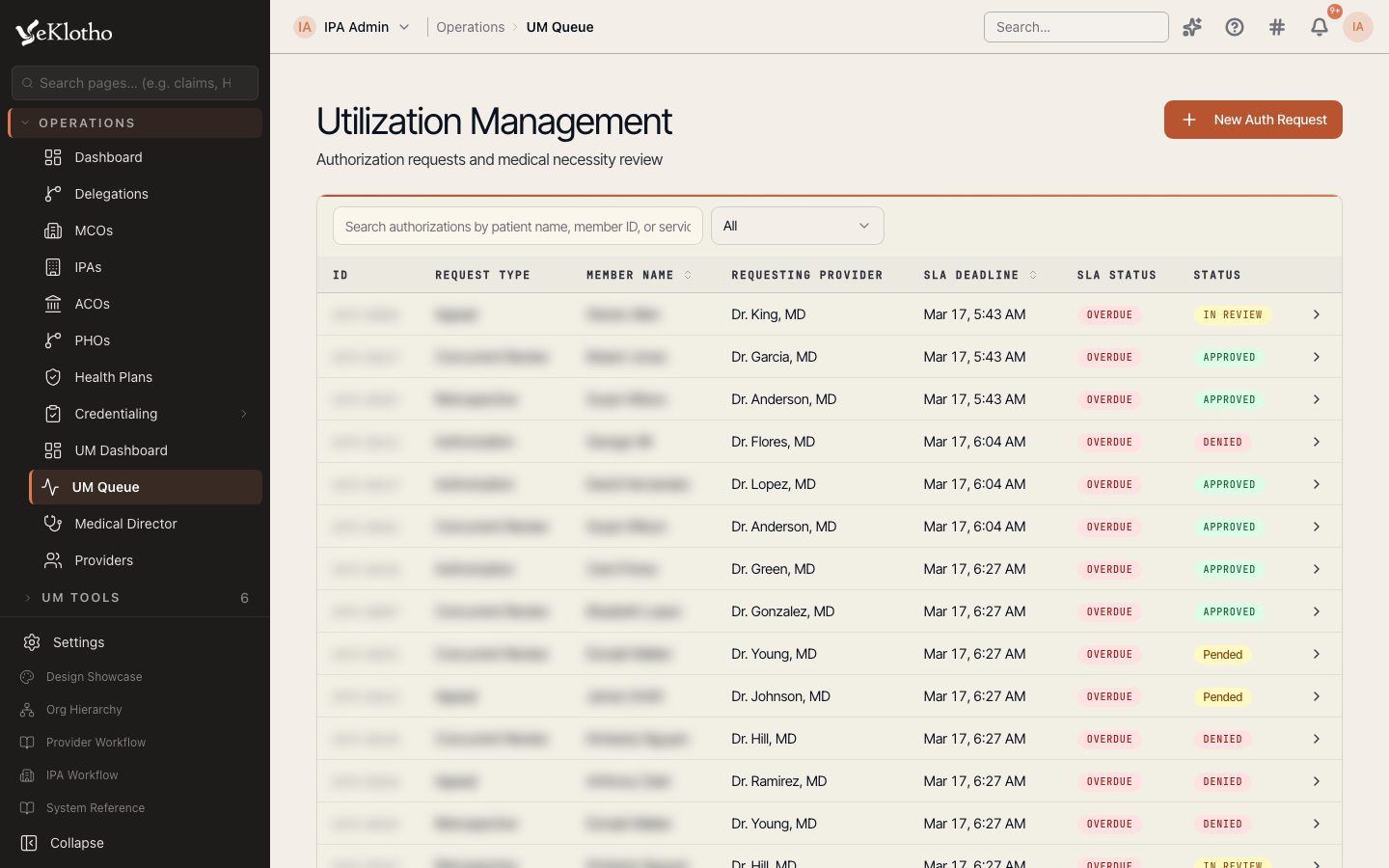
Gets · An authorization queue with SUBMITTED, IN_REVIEW and PENDED states, a clinical criteria library, auto-approval rules with a test endpoint, an EDI 278 log and UM dashboard KPIs.

Credentialing coordinator

Needs · To move applications through verification and committee without chasing expirations in a spreadsheet.

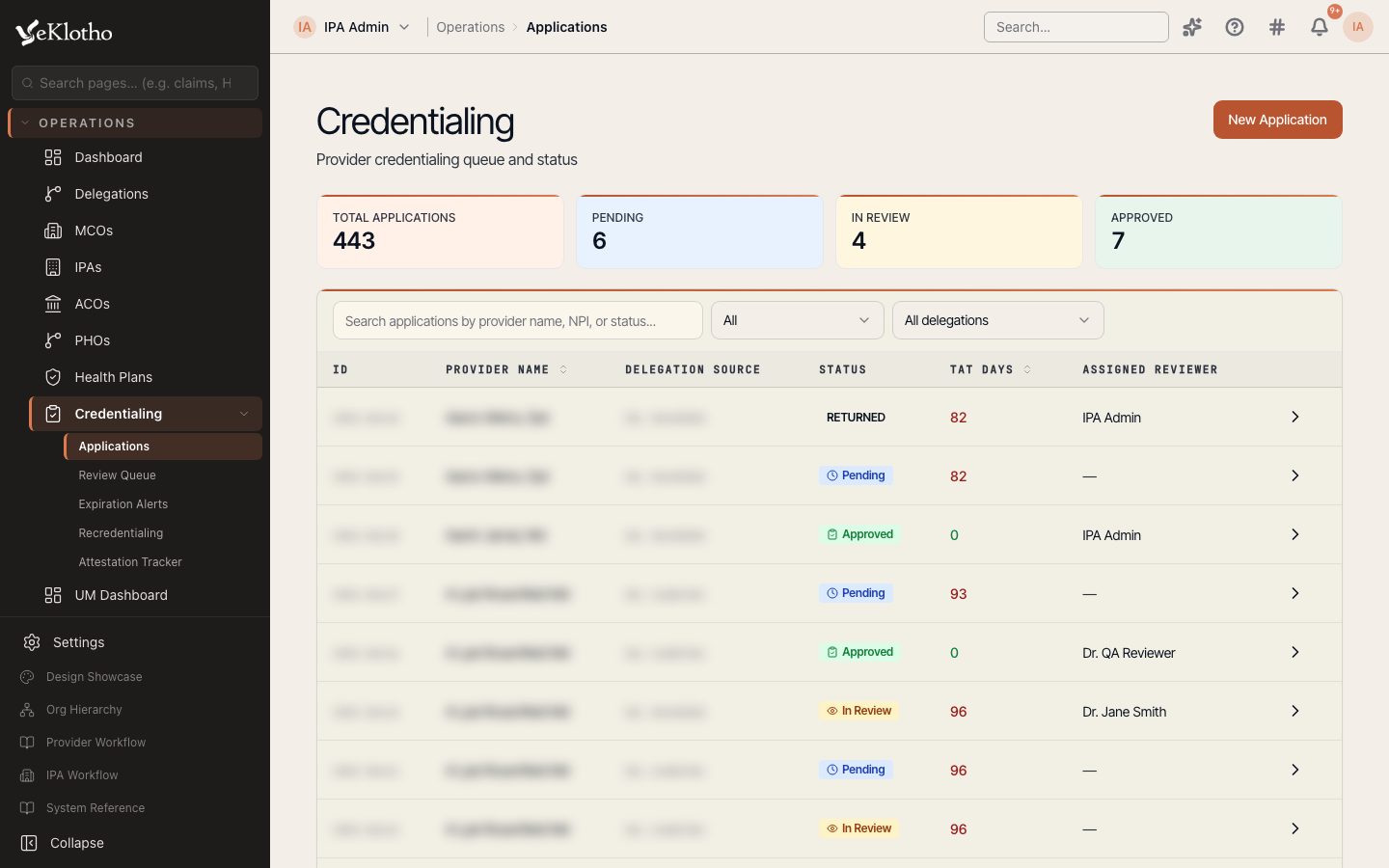
Gets · An application timeline with live NPI checks, a PSV event ledger, a recredentialing queue, an expiration alert scanner, bulk import and CAQH-format roster export.

Claims manager / examiner

Needs · Each claim beside the contract's fee schedule and benefit design, with denials, disputes and appeals tracked instead of re-keyed.

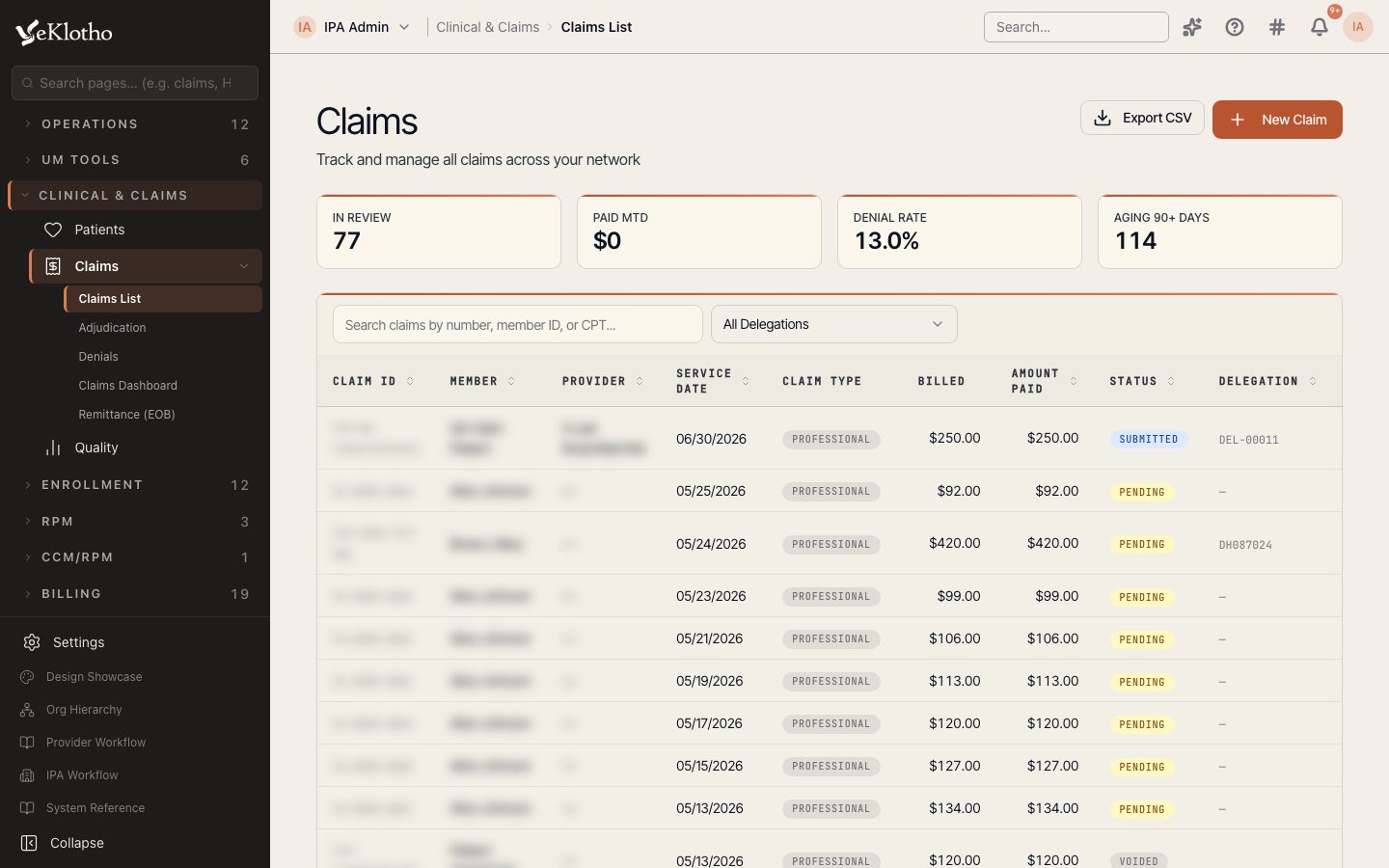
Gets · An adjudication queue with controlled status transitions, fee-schedule and accumulator lookups, COB and crossover, denial and dispute workstations, remittance posting with line reconciliation and CSV export.

Population health lead / care manager

Needs · Open gaps and high-risk members surfaced from current data, outreach that can be tracked, and transitions of care that do not depend on memory.

Gets · Care-gap registries, the patients-by-RAF roster, risk stratification tiers, outreach campaigns, a caseload dashboard with transitions due, and care alerts with resolve and suppress actions.

Today vs. with eKlotho

What actually changes

AreaTodayWith IPA Solution
Delegation auditEvidence is reconstructed from email threads, vendor exports and a shared drive the week before the plan visits.Delegation scopes, attestations, committee decisions, PSV events and UM determinations are records with timestamps; the audit is answered from the system.
Prior authorizationRequests arrive by fax and phone; low-risk services wait in the same pile as complex ones, and the referral and the auth live in different systems.Requests land in one queue — including referrals from the EMR — auto-approval rules clear the listed services, and the rest route to nurse review or the Medical Director with a generated letter.
Credentialing expirationsLicense, DEA and insurance dates live in a spreadsheet someone remembers to check before the 36-month cycle comes due.An expiration scanner produces an alert queue from the credentialing records themselves, and the recredentialing queue sorts by due date.
Claims statusA claim's status is whatever the last person typed; nobody can say who moved it or why.Every status change goes through a state machine that rejects invalid moves and writes an audit row with the user and notes.
Quality and risk adjustmentHEDIS gaps are worked from a plan-supplied list that is months old, and RAF is whatever the plan reports back after the year closes.Gaps sit on the shared record and close when a qualifying lab is signed; RAF is recomputed from signed encounters and shown by patient and tier.
Plan and provider accessEach plan gets a separate export; providers call to ask about their own panel; the MSO keeps a spreadsheet of who may see what.Access is computed from the contract graph: a plan sees its delegated slice, an MSO sees its client IPAs, a provider sees its panel, the IPA sees everything.
Capabilities

What's included

11 modules, each describing what is built today.

Delegation & entity graph

Delegation agreements recorded per health plan with the functions delegated, effective dates, reporting calendars and attestation tracking — the relationship that drives access everywhere else.

Prior authorization (UM)

The delegated-UM workstation: intake by web form, EDI 278 transaction log or referral, clinical criteria at hand, auto-approval rules for low-risk services and a Medical Director queue for the rest.

Credentialing & provider network

Initial applications, primary-source verification (PSV), committee review and recredentialing on one timeline, feeding a provider directory with tiered and specialty networks.

Claims workstation

Professional, institutional and dental claims entered directly, submitted through the API or scanned from paper, then validated, de-duplicated and worked through an adjudication queue with denials, disputes and remittance posting.

Enrollment & eligibility

Member enrollment and coverage records: EDI 834 intake, enrollment periods, plan benefits, accumulators, carve-outs, crossover for dual-eligible members and retroactive changes.

Population health & quality

Care-gap registries, HEDIS measure tracking, Stars dashboards, risk stratification and RAF/HCC intelligence on the shared patient record, with outreach campaigns to close what is open.

Care coordination

Delegated case management and disease management: cases assigned to care managers, longitudinal care plans, transitions of care after discharge, chronic-condition tracking and clinical alerts.

Capitation, risk pools & financials

The money behind delegated risk: capitation batches against enrolled member-months, PMPM rate records, risk pools with withholds and settlements, invoices, payment posting, AR aging and MLR reporting.

Grievances, appeals & regulatory

Member grievance and appeal cases with server-computed SLA deadlines and generated correspondence, alongside the regulatory filing calendar, agency directory and compliance views the delegation requires.

Communications, alerts & documents

Outbound member and provider communications, the platform-wide notification backbone, and an entity-scoped document repository with versions and signed-URL access.

Programs, analytics & administration

Employer groups and FQHC programs for IPAs that run them, analytics dashboards and a query builder, and the administrative console: users, roles, fee schedules, integrations and the audit log.

In depth

How it actually works

The organizational model

The entity graph and delegated access

In managed care, authority flows down a hierarchy: regulators oversee health plans and managed care organizations (MCOs), plans delegate to IPAs, ACOs (Accountable Care Organizations) and PHOs (Physician-Hospital Organizations), and those networks contract individual providers and community health centers. Most software flattens this into isolated tenants. Nexus stores each organization as an entity and each agreement between them as a first-class relationship — DELEGATION, VALUE_BASED_CONTRACT, CONTRACTED_PROVIDER, SERVICE_CONTRACT, EMPLOYMENT and CREDENTIALING — each carrying its scope and effective dates.

Claims operations

The life of a claim

Claims arrive three ways: entered directly as professional, institutional or dental claims, submitted through the REST API, or scanned from paper with vision-model field extraction that a person then verifies. Each claim is validated and de-duplicated on entry, so the queue holds workable claims rather than noise. EDI 837 submission batches are tracked by file and status; parsing of X12 837/835 file contents is on the roadmap.

The revenue model behind delegated risk

Risk adjustment: RAF and HCC

RAF (Risk Adjustment Factor) is the number CMS uses to measure how sick a Medicare Advantage patient is expected to be — and it adjusts what the plan, and downstream the IPA, is paid for that member. The score is not assigned by the doctor: it is computed from the chronic conditions documented as ICD-10 diagnosis codes on encounters. A condition that is real but undocumented contributes nothing, which makes documentation an operational discipline rather than a coding afterthought.

Following the money

Capitation, risk pools and the settlement

Under delegated risk the IPA is paid per member per month, not per service, so the first discipline is knowing what the enrollment actually supports. Capitation batches are computed against enrolled member-months for each delegation and period, with PMPM (per-member-per-month) rate records kept by delegation and period — and the variance between enrolled and capitated membership is surfaced rather than buried in a reconciliation spreadsheet.

Staying audit-ready

The regulatory calendar and delegation reporting

A delegation survives on evidence: the plan's oversight program — typically aligned to NCQA delegation standards — expects the IPA to show that credentialing, UM turnaround and quality reporting meet the agreement. Nexus keeps the obligations visible: a regulatory filing calendar and agency directory covering CMS, state Department of Insurance and NCQA deadlines, preparation pages with filing status, and statistics packets assembled for plan and agency reporting.

Quality that closes itself where the data allows

From care gap to closed measure

Quality work starts with knowing who is open. Care gaps are tracked per member with evidence status and linkage to the HEDIS (Healthcare Effectiveness Data and Information Set) measure they belong to, and measures are tracked per delegation and measurement year — the same way the plan will score them. Risk stratification tiers, disease registries, pharmacy-adherence views and social-determinants data define the cohorts worth acting on first.

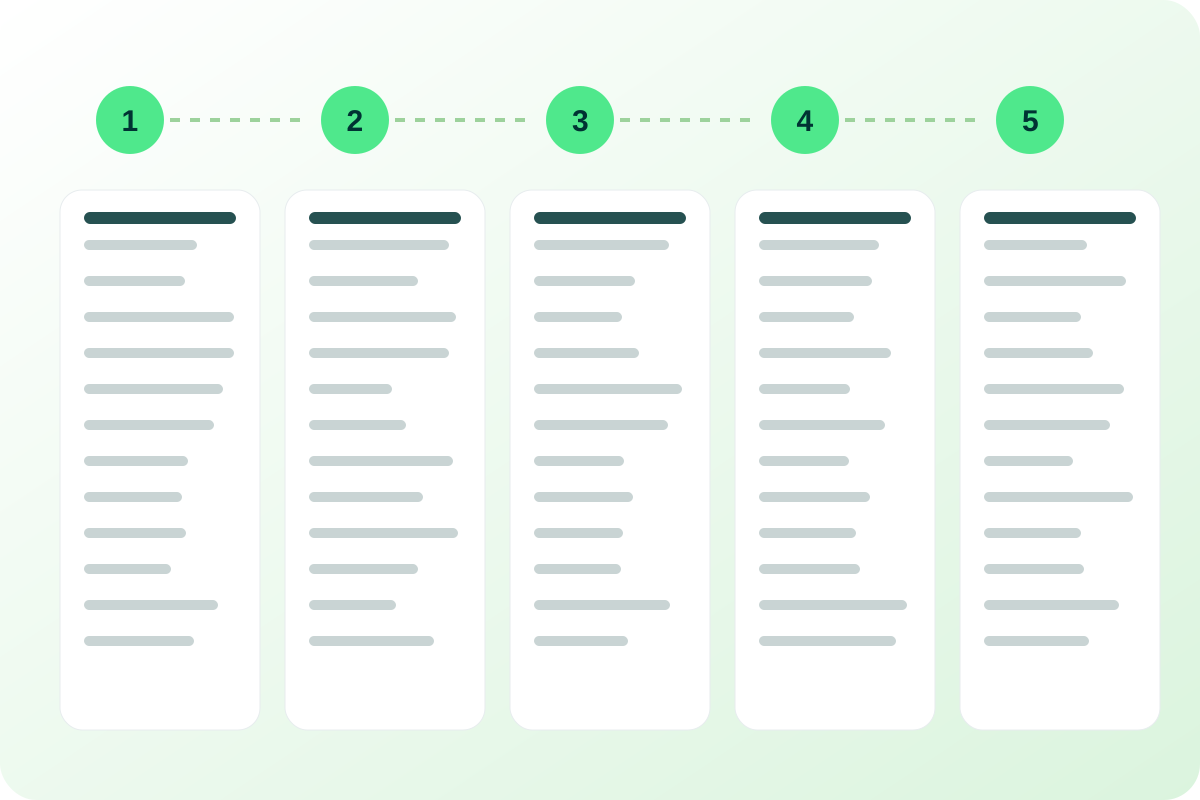
How it works

From first step to outcome

  1. Onboard the delegation

    Create the IPA, its health-plan relationships and the scopes each plan delegated (UM, credentialing, claims, quality) with effective dates. Upload the agreement and reporting calendar. Access for every user now follows the contract.

  2. Credential the network

    Applications arrive by intake form, self-submission or bulk import. NPI is verified live against NPPES and logged as a PSV event; the committee records its decision; approved providers become contracted-provider relationships and receive access. The recredentialing queue and expiration alerts keep the multi-year cycle on schedule instead of in a spreadsheet.

  3. Run delegated UM and claims

    Authorization requests land in one queue — including referrals placed in the EMR, which the delegation contract routes to auto-approval, nurse review or the plan — with turnaround visible on the UM dashboard. Claims are validated, worked through the adjudication queue and posted against remittance.

  4. Close gaps and manage risk

    Care gaps, HEDIS measures and RAF/HCC capture sit on the shared record; signed labs close measures, outreach campaigns go to cohorts, and care managers work cases and transitions of care.

  5. Settle and report

    Capitation, risk pools, withholds and settlements are calculated from enrolled member-months, with MLR reported by period; filings, grievance SLAs and delegation attestations are answered from the same records the teams work in.

A closer look

Screens and flows

Credentialing
Credentialing — applications, verification status and recredentialing on one timeline (demo environment, synthetic data).
Claims list
Claims list — claims across the network with status, billed and paid amounts, and delegation (demo environment, synthetic data).
Utilization management
Utilization management — the authorization queue with criteria and Medical Director review (demo environment, synthetic data).
How we make sure

The mechanics behind the claims

Every promise on this page maps to something the software actually enforces.

A plan sees only what it is delegated
Each query is scoped by the entity and accessible-entity grants carried in the signed session token, computed from delegation and contract relationships rather than a tenant flag. Unknown or unreachable organizations return not-found, never a partial view.
A referral in the chart becomes an authorization in your queue
When a clinician places a referral in the eKlotho EMR, a UM hook evaluates the IPA's delegation with the patient's plan and the auto-approval rules, then either mints the authorization, opens a SUBMITTED review in the Nexus queue, records that the plan owns the auth, or records that no authorization is required. The hook never blocks the referral and is retried by cron if Nexus is unavailable.
Authorization decisions are traceable
UM reviews move only through SUBMITTED, IN_REVIEW and PENDED working states to the terminal APPROVED or DENIED; each change is written to a status history, the determination generates a PDF letter, and appeals are tracked as their own records with decisions.
A claim cannot skip a step or be quietly reopened
All status changes funnel through a transition table; an invalid move returns an error, and every valid one writes an audit row with the user and notes.
Verification is evidence, not a checkbox
Each NPI check against NPPES appends an event to the PSV ledger with its source and result; committee decisions are stored with rationale and a timestamp; signed attestations are invalidated with a reason note rather than removed.
Risk and quality reflect care as it happens
Signing an encounter in the EMR fans out to a durable outbox that recomputes the patient's HCC summary from signed diagnoses; signing a qualifying lab maps its LOINC code to the HEDIS measure and marks the numerator met for that patient and year.
Outcomes

What changes for your team

  • Delegation audits answered from timestamped records — scopes, PSV events, committee decisions, determinations — instead of reconstructed from files
  • Authorization requests intake by form, EDI 278 or EMR referral, are evaluated against criteria and auto-approval rules, and route to the Medical Director with determination letters generated as PDF
  • Claims flow through validation, the adjudication queue, COB and remittance with an audit trail on every status change; denials, disputes and flags route to dedicated workstations
  • Providers credentialed on one timeline with a recredentialing queue and expiration alerts, and a network directory with tiered and specialty groupings
  • Care gaps and RAF/HCC documentation opportunities visible to the COO and, through the EMR, to the clinician at the point of care
  • Risk-pool settlements and capitation variance computed from enrolled member-months, with withholds tracked and released per contract
  • One source of truth shared by the IPA, its health plans and its physicians — no export-import between the admin platform and the chart
FAQ

Common questions

Terms on this page

IPA
Independent Practice Association — a network of independent physicians that contracts with health plans and takes on delegated functions under capitation or shared risk.
Delegation
A health plan's written transfer of a function (UM, credentialing, claims, quality) to the IPA, with defined scope, effective dates and plan oversight.
UM
Utilization management — reviewing requested services against clinical criteria, including prior authorization, with turnaround times the plan audits.
PSV
Primary-source verification — confirming a credential directly with the issuing body, such as an NPI check against the NPPES registry.
HEDIS
Healthcare Effectiveness Data and Information Set — the quality measure set health plans report and pass down to delegated groups.
RAF / HCC
Risk Adjustment Factor and Hierarchical Condition Categories — the CMS model that adjusts Medicare Advantage payment for documented patient complexity.
PMPM / capitation
Per-member-per-month — the basis for capitation payments received from the plan and allocated across the network.
Risk pool
A contract-level fund — withholds, shared savings or deficit — tracked through the performance period and settled with the plan.
COB
Coordination of benefits — determining which payer is primary and which is secondary when a member holds more than one coverage, including Medicare/Medicaid crossover.
MLR
Medical loss ratio — the share of capitation or premium revenue spent on medical care over a period, reported to plans and regulators as a measure of where the money went.
Is this multi-tenant software with one tenant per IPA?

No. Nexus models the relationships between regulators, plans, IPAs, practices and providers and computes access from them. A health plan can be delegated to several IPAs and see each slice; an MSO can administer several client IPAs; a provider can belong to more than one network.

Which delegated functions does it cover?

Utilization management, credentialing, claims, quality reporting, enrollment and eligibility records, care management and the financial settlement that goes with them. Each is a separate scope on the delegation record, so the IPA can show a plan exactly what it is accountable for.

How does prior authorization reach the Medical Director?

Requests enter by web form, EDI 278 transaction or as referrals from the eKlotho EMR. Auto-approval rules clear the services your contract lists; everything else moves to nurse review and then the Medical Director queue, where the determination is recorded with rationale and a PDF letter is generated. Appeals are tracked as their own records.

What does credentialing verify automatically?

NPI status is verified live against the NPPES registry and written to the PSV ledger with its source and result. Other primary sources — licensure boards, OIG and SAM exclusion lists, NPDB — are pluggable drivers on the roadmap; today their evidence is recorded as attachments and attestations.

How do claims get in, and does the system adjudicate them?

Professional, institutional and dental claims are entered directly, submitted through the API or scanned from paper. The examiner works each claim in an adjudication queue with the contract's fee schedule, benefit design and accumulators beside it; status changes go through a state machine. EDI 837 batches are tracked by file; X12 parsing of 837/835 is on the roadmap.

How are HEDIS measures and RAF scores kept current?

Measures are tracked per delegation and measurement year on the shared patient record, and a qualifying lab signed in the EMR closes the numerator for that patient and year. RAF is recomputed from signed encounter diagnoses using the CMS-HCC V28 model and surfaced on the RAF dashboard and patients-by-RAF roster. A nightly HEDIS batch engine is on the roadmap.

How does it connect to the clinics?

The eKlotho EMR reads and writes the same patients table, so a referral placed in the chart opens a UM review in your queue, a signed encounter builds a draft claim and recomputes HCC, and care gaps appear in the chart — with no interface engine between the two.

How do capitation and risk-pool settlements work?

Capitation batches are computed against enrolled member-months per delegation and period, with the enrolled-vs-capitated variance surfaced. Risk pools track withhold balances and surplus or deficit per contract; interim and final settlement runs are computed with their history preserved, alongside a shared-savings summary and MLR reporting by period — so the year-end reconciliation with the plan starts from traceable numbers.

What are the options for exchanging data with plans and vendors?

A REST API for direct submission and retrieval, EDI 834 enrollment file intake, 837 batch tracking, a 278 transaction log, CAQH-format and payer roster exports, and signed-URL document exchange through AWS S3. Live 270/271 eligibility inquiry and X12 parsing of 837/835 file contents are on the roadmap.

See IPA Solution on your own workflows

We walk through it with your data and your team — not a canned demo.

Program and billing eligibility are determined by each practice and its payers. Results and alerts do not constitute a medical diagnosis. Third-party names are trademarks of their respective owners and do not imply endorsement.